

What Does a Home Inspection Cost?
A Smart Buyer's Guide to Price, Value, and the Right Questions to Ask
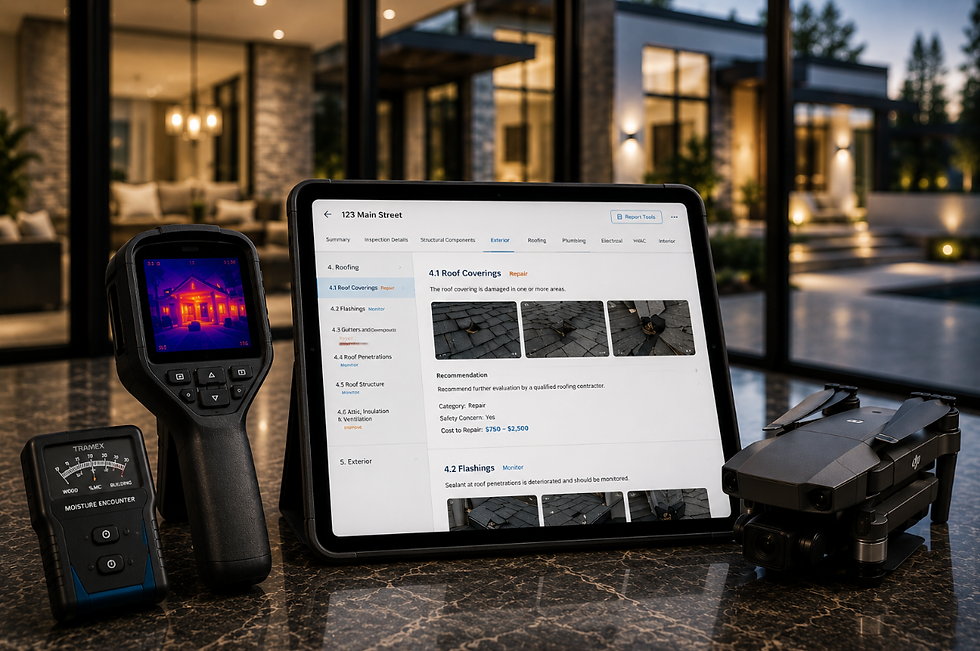
Price is usually the first question a buyer asks about a home inspection, and it is a fair one. But it is also the question most likely to lead you astray, because the cheapest inspection and the best inspection are rarely the same thing. The goal of this guide is to help you understand what an inspection actually costs, what drives the price, which services are worth requesting, and how to tell the difference between a low price and a good value.
What a home inspection actually costs
For a typical single-family home, a professional inspection generally falls within a few hundred dollars, with larger, older, or more complex homes costing more. Specialty and lab-based services are usually priced separately.
A few factors move the number:
• Size and age of the home. More square footage and older systems take more time to inspect properly.
• Complexity. Multiple HVAC systems, additions, outbuildings, steep or tall roofs, and finished basements all add scope.
• Add-on services. Radon testing, mold or water sampling, and similar lab services carry their own fees because they involve instruments, lab work, and a separate turnaround.
• What is already included. This is the big one, and the part most buyers overlook. With some inspectors, tools like thermal imaging cost extra. With others, they are built into the base price.
In other words, two quotes that look different on paper may not be comparing the same thing at all. Before you judge a price, find out what that price actually buys.
Why the lowest price is rarely the best value
A home is one of the largest purchases you will ever make, and the inspection is the one step that tells you what you are really buying. The lowest bid often reflects less time on site, fewer diagnostic tools, a thinner report, or less experience reading what a home is telling you. Any of those can mean a missed defect, and a single missed roof, foundation, or moisture issue can cost thousands to tens of thousands of dollars after closing. Measured against that, the difference between a budget inspection and a thorough one is small. Price the inspection against the risk it protects you from, not against the next quote on your list.
The questions every buyer should ask before hiring an inspector
These questions cut through the noise and let you compare inspectors on what actually matters:
• Is thermal imaging included, or is it an extra charge? Thermal imaging helps reveal hidden moisture, missing insulation, and overheating electrical connections. With many inspectors it is an add-on. Ask whether it is standard.
• Do you offer drone roof inspection, and is it included when weather permits? Steep, tall, or fragile roofs are difficult to assess from a ladder. Drone coverage gives a complete, safe look at the roof surface.
• How detailed is the report, and how soon do I get it? A clear, photo-rich report delivered quickly is part of what you are paying for, because you are often working inside a tight contract timeline.
• Are repair cost estimates provided? Knowing the likely cost of an identified issue puts you in a far stronger position to negotiate.
• What is not included, and what are the add-on costs? A trustworthy inspector tells you plainly what is and is not part of the inspection, with no surprises.
• Are you licensed, insured, and a member of a recognized inspection body? These are baseline credentials worth confirming before you hire anyone.
How to decide which services to request
Start with a full home inspection on every purchase, then layer on services based on the home in front of you:
• Radon testing. Strongly recommended on nearly every transaction in our region, where elevated radon is common.
• Drone roof analysis. Worth it for steep, tall, multi-level, or slate and tile roofs that cannot be safely walked.
• Moisture and thermal evaluation. Especially valuable in older homes, finished basements, and anywhere you suspect a past leak. Undetected moisture can lead to mold, which can cause health problems.
• Mold or water testing. Consider these when there is a visible concern, a private well, or a sensitive household.
• Pre-drywall or new construction inspection. New builds have defects too, and a pre-drywall look catches what later gets sealed behind the walls.
If you are not sure, a good inspector will help you decide which services fit your specific home rather than simply selling you everything.
Why a higher price often reflects more value
When an inspection costs more, it is frequently because more is included in it. A higher price can reflect thermal imaging in every inspection rather than as an upcharge, drone roof coverage when weather allows, a thorough multi-point report with photos, fast turnaround, repair cost estimates to help you budget, and an inspector who stays available to answer your questions after delivery. You are not just buying a checklist. You are buying time, judgment, better tools, and someone who will stand behind the work. Viewed that way, a modestly higher price is often the better deal, not the worse one.
What this means in Maryland and Washington, DC
Our region raises the stakes on getting this right. Elevated radon is widespread across Maryland and present in DC. Older and historic homes can carry lead-based paint, dated wiring, and polybutylene plumbing. Humid summers and a housing stock full of basements and crawl spaces give moisture plenty of ways in. The right combination of services, performed by a thorough inspector, is exactly how you turn those regional risks into known, priced, manageable facts before you commit.
Frequently asked questions
Is the cheapest inspector always a bad choice?
Not always, but price alone tells you very little. Compare what is included, who performs the inspection, and the quality of the report before you decide. A low price paired with thin coverage is where buyers get hurt.
Does thermal imaging really cost extra elsewhere?
With many inspectors, yes, it is billed as an add-on. At Thoroughbred, thermal imaging is included in every inspection at no extra charge.
Which add-on do most buyers in our area choose?
Radon testing is the most common, because elevated radon is widespread across our region. We recommend it on nearly every transaction here.
Can I just get the base inspection?
Absolutely. The full home inspection is the foundation. We will help you decide whether any additional services make sense for your specific home, with no pressure to add what you do not need.
Know what you are buying, and what it is worth.
Thoroughbred Property Inspections LLC | Serving Maryland & Washington, DC
www.ThoroughbredPI.com | 410-505-7127 | info@thoroughbredpi.com
Licensed & Insured | InterNACHI Member


Comments